Showing posts with label Parliament. Show all posts

Sunday, August 29, 2010

Estonian Parliament

The entrance to the Parliament

The Estonian Parliament is a curiously eclectic building in the heart of Tallinn’s Old Town just behind the ornamental three-domed building of the Russian Orthodox Nevsky Cathedral. Nevsky Cathedral

This building complex blends completely into its surrounding like a chameleon, so much so that each side of the building comes from a different century. The backside of the building is actually the original town walls blending into a medieval castle.

HPIM7312

Inside the building one finds the usual accessories of parliamentary buildings with a courtyard to solve any parking problems of cabinet members and deputies, large reception areas with exquisitely woven carpets and overhanging chandeliers, offices and of course the debating chamber.

The blue room that accommodates the hundred or so MPs is situated in the blue part of the building and as a nice feature it receives natural light from the courtyard, which surely helps the deliberation and cuts down on the electricity bill.HPIM7314

Thursday, May 20, 2010

The Welsh Assembly

Front view of the Senned
On my January visit to Cardiff I chanced upon the second devolved parliament of Britain that is not housed in an ordinary building (I haven't yet had the chance to visit Belfast, but I imagine Stormont to be a more traditional building). The Welsh National Assembly building is located in the bay area of the town next to the iconic Millenium Centre.

The debating chamber's walls become the roof
The building was finished in 2006 and it projects the image of transparency, openness.One also notices the prominent use of natural materials such as wood and glass. The steps in front of the glass portal of the building covered by the wavy, overhanging roof made of wood are inviting to the public and fit well into the area with the sea nearby and the rainy English weather. The whole building suggest looking out to the sea, the people and looking forward to the future, as well as invitingly offering shelter.

Tuesday, May 18, 2010

Slovakian Parliament

National Council of the Slovak Republic
On my last trips to Bratislava unfortunately I didn't get to visit the Slovakian Parliament's building. It is located in the best possible place of the town, next to the castle. Unfortunately, it is quite an uninteresting (from outside), gray, concrete building next to the imposing castle so most tourists probably don't even realize its significance and head directly through the gate on the opposite side of the street to the castle grounds.

Sunday, February 14, 2010

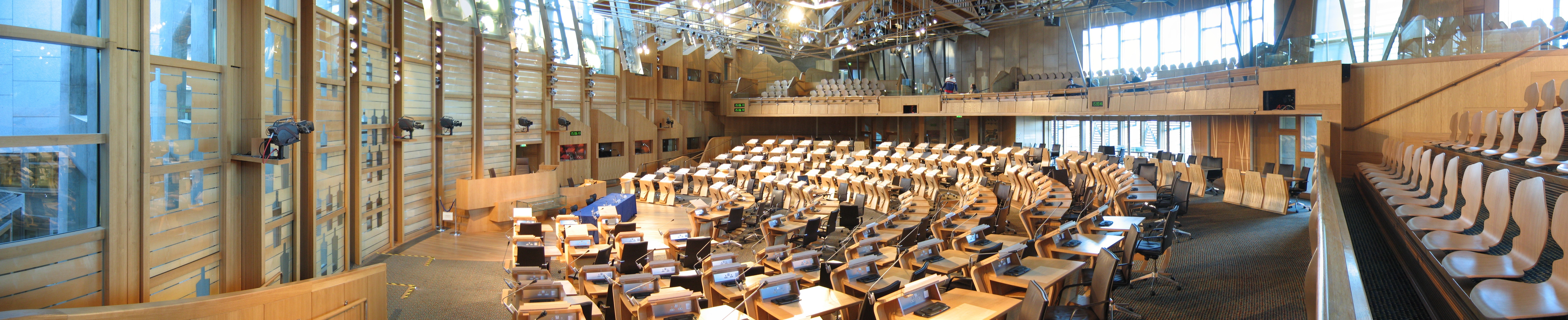
Scottish Parliament – no icon, no Ikea

During my farewell trip to Estonia I made a stop in the UK and visited the various parliament buildings in Great Britain. One of the interesting and frankly quite strange ones was the Scottish Parliament building in Edinburgh.

It is quite difficult for me to decide whether I liked the building complex that is well over-packed with symbolism and Scottish cultural references, which are an achievement in their own right as the architect, who died before he could explain what he meant by the building, was not Scottish. It feels as if someone has bulk ordered some modern symbolism and applied it all to the building without discrimination.

My ambiguity – apart from my aversion to symbols that would be enough to fill a Dan Brown trilogy – probably stems from the fact that I was not expecting a new, modern building for a Parliament that is centuries old (although not in existence for 300 years). The building itself is quite functional from the inside (with bare cement walls in places and a very big and roomy debating chamber) and very strange from the outside. Only, if one would look down on the building from the nearby mountain would he discover that the building is supposed to symbolize the petals of a flower; however, he would probably have a hard time realizing this as the grass on the roof makes it difficult to make out the shape.

Edwin Morgan puts it quite elegantly and accurately in his poem:
Is it not a mystery? The parts cohere, they come together
like petals of a flower, yet they also send their tongues
outward to feel and taste the teeming earth.
Did you want classic columns and predictable pediments? A
growl of old Gothic grandeur? A blissfully boring box?
Not here, no thanks! No icon, no IKEA, no iceberg, but
curves and caverns, nooks and niches, huddles and
heavens syncopations and surprises. Leave symmetry to
the cemetery.
But bring together slate and stainless steel, black granite
and grey granite, seasoned oak and sycamore, concrete
blond and smooth as silk – the mix is almost alive – it
breathes and beckons – imperial marble it is not!
Debating chamber. Image from Wikimedia Commons.

More pictures at the Parliament website.

Sunday, June 7, 2009

Queen's Champion

The office of the Queen's Champion is an important hereditary office in the United Kingdom that apparently dates back to 1066. The duties to be performed in exchange for the 12 km² Manor of Scrivelsby are not manifold, but all the more dangerous. Until the coronation of George VI in 1821 his duty was to challenge to duel those who would not accept the new monarch.
At the coronation banquet he would throw down his gauntlet three times and a herald would issue a challenge among the following lines:
If any person, of whatever degree soever, high or low, shall deny or gainsay our Sovereign Lord George, King of the United Kingdom of Great Britain and Ireland, Defender of the Faith, son and next heir unto our Sovereign Lord the last King deceased, to be the right heir to the imperial Crown of this realm of Great Britain and Ireland, or that he ought not to enjoy the same; here is his Champion, who saith that he lieth, and is a false traitor, being ready in person to combat with him, and in this quarrel will adventure his life against him on what day soever he shall be appointed.
The champion was loaned the second best horse in the Royal Mews and an armor which was his for the keeping if anyone took up the challenge and the champion has won; otherwise he would get a cup from which the sovereign has drunk the champion's health.
There are no certain records that would show that anyone accepted the challenge, though there are some rumours about different Jacobites doing so.
After George VI the tradition of holding a coronation banquet in Wetminster Hall (the building of the Houses of Parliament) was abandoned and thus the life of champion became simpler, until the 20th century. In 1902 the then champion petitioned the Court of Claims -- the special court set up at every coronation to decide on who gets to perform what service at the coronation -- and since then his duty is to carry the Royal Standard at the coronation.

Find out more on Wikipedia; the painting comes from this website. A nice way to learn about chivalric traditions and the way a proper challenge was accepted and fought out is to read the Song of Roland from the eleventh century.

British Parliamentary archive as VOD

I just stumbled accross the online video archive of the Parliament of the United Kingdom, where meetings of the last 12 months can be watched. (The written records going back centuries are partially available online, as well.) In theory, this allows everyone who has a vague idea about the British Parliamentary style to experience it with their own eyes -- the only obstacle is to sift through the boring stuff where only one or two members are present and find the good debates between e.g. Gordon Brown and David Cameron.
Among the more interesting videos I found is the motion for a humble address in the Lords (at just before the 2-minute mark) and the state opening of Parliament by the queen.

Friday, May 29, 2009

Clandestine outlawries

I am a big admirer of long-kept traditions and I am always happy to see one survive or flourish. Thus, I was happy to discover a British Parliamentary tradition that has been kept for over three hundred years and has been exported to other Commonwealth countries as well.

When a new session of Parliament is opened the Queen (or her representative) makes a speech from the throne in the upper house of Parliament. (According to tradition she is not given entry to the House of Commons.) After the speech is read both chambers of Parliament demonstrate that the Queen is in no position to set the agenda of debate so in defiance they introduce a bill for a first reading (which means they first read the title of the bill and then decide whether to discuss it further in committees). For the last three hundred or so years this bill has been the same in the United Kingdom: in the Houses of Commons it is “A Bill for the more effectual preventing clandestine Outlawries” and in the House of Lords “A bill for the better regulating of Select Vestries”).

The Outlawries Bill basically sets up measures to prevent people from declaring their fellows “outlaws” in secret and also has some extra penalties for sheriffs doing this.

The Select Vestries Bill deals with the rights of “select vestries” to administer poor law.

In Canada the bills are titled “An Act respecting the Administration of Oaths of Office” and “An Act relating to Railways”. It is worthwhile to read the actual texts of these two bills that have been printed maybe for the first time ever in 2009. It is a good indication of the serious thought behind these pro forma bills is that the text stops after a short and one clause reading:

This bill asserts the right of the Senate to give precedence to matters not addressed in the Speech from the Throne.

After this pro forma bill, as far as I can see from the Hansard records I’ve seen online, the Speaker informs the members that he has obtained the Queen’s speech “for greater accuracy” and then a member moves to present an humble address to the Queen along the lines of:

Most Gracious Sovereign—We, Your Majesty’s most dutiful and loyal subjects, the Lords Spiritual and Temporal in Parliament assembled, beg leave to thank Your Majesty for the most gracious Speech which Your Majesty has addressed to both Houses of Parliament

After some long speeches by the mover and the seconder of this address, the actual work of Parliament begins.

Saturday, June 28, 2008

Illegal to die in the Houses of Parliament?

I have spent the last couple of hours trying to track down the law that states that it is illegal to die in the Houses of Parliament. I have heard about it from a friend, and doing a search on Wikipedia didn't yield any verifiable results.

There are three mentions of this in Wikipedia, two of them linking to two newspaper articles, one stating that this law has been voted the most ridiculous while the other that the practice is to mark St. Thomas' hospital as a place of death in cases anybody breaks the law and dies there. Neither of these articles provide the source, or the actual name of the law that would state this, and I have not found it in neither of the online law databases of the UK I have checked. I couldn't find that law either that would say that those dying in a royal palace have to receive a state funeral, the closest thing was the Coroners Act 1988, that states that inquests into the deaths of persons lying inside one of the Queen's palaces are done by the Queen's coroner; alas no mention of a state funeral.

While the third about Spencer Perceval, the only British prime minister to have been assassinated, while seems to misquote his last words (either, according to the article "I am murdered" or according to the 10 Downing Street website "Oh, I have been murdered") states without providing a source that it is only illegal to die in the House of Lords.

Thus I have to think that this is probably an urban legend, though quite interesting nevertheless. Through my quest I have found the law that states that whales belong to the King.