Tuesday, March 16, 2010

Combating link rot on Wikipedia

Wikipedia's W (favicon). The "W" ori...Image via Wikipedia
One of the main principles of Wikipedia is verifiability, the idea that any fact you find in an article can also be found in a reliable external source (that's why there are so many footnotes in any given Wikipedia article). These external sources can either be offline paper products or more often than not online web pages. Unfortunately, web pages often change or become unavailable, a process nicknamed link rot , which goes counter to the ability of verification.

One way to combat link rot and to ensure that a reader can always find the sources used to make up a Wikipedia article is to rely on online archiving services such as the Internet Archive or WebCite. The solution to the problem is to submit each linked web page to the archives' attention to make sure they will have a copy of the referenced webpages in the eventuality that they become unavailable.

There is no automatic way to submit all links on a Wikipedia to an archive and different projects have come up with different solutions. The English Wikipedia used to send every new link added to the various articles to the WebCite archive (to the point that said archive had to increase server capacity). The French Wikipedia have devised a way to link to an archived version of linked pages at the Wikiwix search engine, but I don't know the particulars.

So far the Hungarian Wikipedia doesn't have a systematic way of eliminating dead external links. As a first step in the right direction I slightly modified a component of the Pywikipedia framework to go through every single page in the Hungarian Wikipedia and send every external link to the WebCite archive. The method was inefficient because I am not a programmer and both Python and the WebCite website often crashed. (The ideal program would have used the external links database dump that contains only the links without the irrelevant article text.)

As a results of my efforts the vast majority of the external web pages that were linked from the Hungarian Wikipedia and were alive at the end of 2009 can now be found in the WebCite archive. (Such as this copy of the Nobel prize website.) I will run my program periodically to include new links added to articles.

The logical extension of my work would be to include the links to the archived versions next to the links themselves if a page dies. This could be done either manually or automatically, however I haven't the expertise or time to make this happen.

Saturday, February 27, 2010

Deeper explorations of international law

A trial at the Old Bailey in London as drawn b...Image via Wikipedia
I have to come up with a plan and the first chapter for my thesis on peremptory norms (jus cogens) in international law and I am  considering participating in a competition that touches upon State immunity, diplomatic immunity of Heads of States and probably the right to self-defense. 
Consequently, I had to immerse myself very deeply in details of international law and there are some very interesting facets.

It seems that one has to be quite the magician to traverse this field where one and the same court case can be used in arguments both pro and contra and where practice doesn't seem to follow theory, yet we are assured that practice is at fault. I believe this is one of the reasons why there is so much academic activity surrounding it, thought it is not totally without interest to non-experts.

In my explorations I have stumbled upon two very interesting blogs that reflect on  current issues (such as the current Falklands dispute, the US drone attacks or the alleged Mossad hit in Dubai) and their implications in international law. Both the blog of the European Journal of International Law, EJIL: Talk! and Opinio Juris  write in an accessible language and present interesting arguments from leading scholars in the field.

Sunday, February 14, 2010

Scottish Parliament – no icon, no Ikea

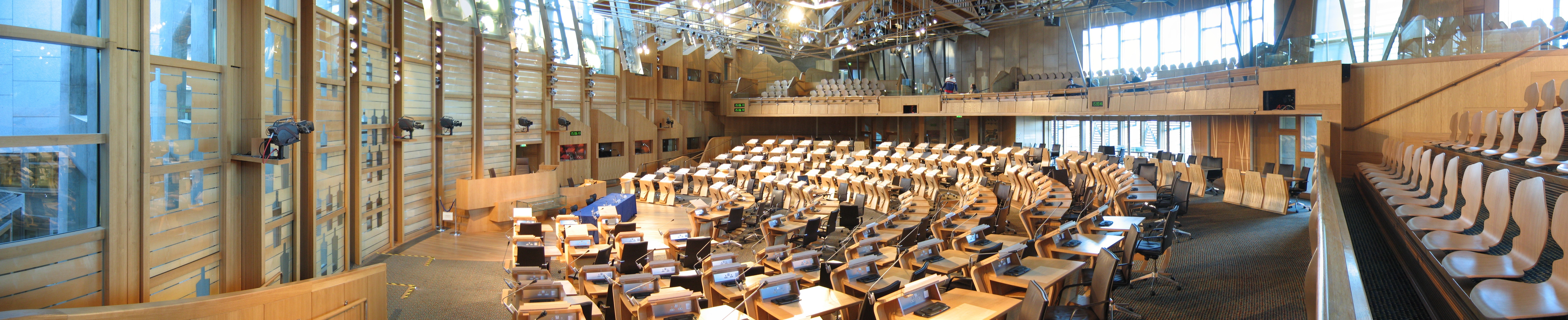
During my farewell trip to Estonia I made a stop in the UK and visited the various parliament buildings in Great Britain. One of the interesting and frankly quite strange ones was the Scottish Parliament building in Edinburgh.

It is quite difficult for me to decide whether I liked the building complex that is well over-packed with symbolism and Scottish cultural references, which are an achievement in their own right as the architect, who died before he could explain what he meant by the building, was not Scottish. It feels as if someone has bulk ordered some modern symbolism and applied it all to the building without discrimination.

My ambiguity – apart from my aversion to symbols that would be enough to fill a Dan Brown trilogy – probably stems from the fact that I was not expecting a new, modern building for a Parliament that is centuries old (although not in existence for 300 years). The building itself is quite functional from the inside (with bare cement walls in places and a very big and roomy debating chamber) and very strange from the outside. Only, if one would look down on the building from the nearby mountain would he discover that the building is supposed to symbolize the petals of a flower; however, he would probably have a hard time realizing this as the grass on the roof makes it difficult to make out the shape.

Edwin Morgan puts it quite elegantly and accurately in his poem:
Is it not a mystery? The parts cohere, they come together
like petals of a flower, yet they also send their tongues
outward to feel and taste the teeming earth.
Did you want classic columns and predictable pediments? A
growl of old Gothic grandeur? A blissfully boring box?
Not here, no thanks! No icon, no IKEA, no iceberg, but
curves and caverns, nooks and niches, huddles and
heavens syncopations and surprises. Leave symmetry to
the cemetery.
But bring together slate and stainless steel, black granite
and grey granite, seasoned oak and sycamore, concrete
blond and smooth as silk – the mix is almost alive – it
breathes and beckons – imperial marble it is not!
Debating chamber. Image from Wikimedia Commons.

More pictures at the Parliament website.

Monday, December 21, 2009

Dinosaurs Were Made Up by the CIA to Discourage Time Travel


I wish the band Math the Band would have come up with something less electronic and more fun/clever with such a good title...

Saturday, December 19, 2009

The long way home

I am finally back in Budapest, after quite an exhausting journey that has taken many turns and twists. After 5 hours of sleep and some last-minute packing I was on my way to Tallinn airport witnessing the snow covered plains and forest of Estonia and the sunset at around 4 pm.

At the airport I was among the first to check in, which was not much help as my plane was an hour late, meaning that I was going to miss my connection in Frankfurt. Finally, we landed just as my second plane was supposed to take off, and I was taken by the airport bus to a gate about a kilometer away from the gate I was supposed to be at half an hour earlier

Fortunately, the second plane was delayed as well so I could make it (after covering the 1km distance between my arrival and departure points in record time, they moved my gate much closer). In the end we took off twenty minutes after we were supposed to land already and had a smooth ride.

After the pilot missed the bridge connecting to the terminal by about a metre and had to order the anxious passengers back to their seats, I was finaly at home again:

Thursday, December 10, 2009

Look at the Birdie


I just finished reading Kurt Vonnegut's latest posthumous collection of short stories, entitled after one of the stories Look at the Birdie and in doing so I think I managed to read almost every book of his. The collection includes 14 previously unpublished stories.

These stories have the markings of typical Vonnegut works, with black humour, science fiction and absurd situation. I liked the stories, some of them more than the others, and I must admit, there was one or two that I did not get. Either way, I recommend the book to everyone who likes Vonnegut's style and earlier books.

Now that I have finished reading, I can start boxing up my books and sending them home...

Wednesday, December 2, 2009

And Another Thing...


I just finished reading Eoin Colfer's addition to the Hitchhiker's Guide universe, the book entitled And Another Thing.
The book written as an appendix in the Guide to the entry on the Hitchiker's Guide is a welcome addition to the trilogy (of five) even if it cannot be the same if the same author would have finished the series.
Eoin Colfer in my opinion has understood well the dynamics of the story and has come up with a plausible continuation and introducing some interesting new themes.
And Another Thing has a similar kind of language to the H2G2, yet without such memorable phrases as "mindbogglingly", "almost, but not quite, entirely unlike tea", and "The ships hung in the sky in much the same way that bricks don't."
There are, however, many excerpts from the Guide to provide background on some of the developments of the earlier books (which are quite unnecessary for the real Hitchiker's fans) and for comic relief. These replicate the style of Douglas Adams but are a little too numerous and a tad bit weak in some cases.
Still, I would recommend this book as a fun and light read and a nice way to honour the work of a great author.